The whole class is involved in the tour guiding scheme with Historic Scotland. We have learned our scripts thoroughly and have performed several times at the Bishop's and Earl's Palaces.We have some more bookings to complete before the summer break and will hopefully get more after the holidays. Here we are at the dress rehearsal.
We got a mention in the Press and Journal, The Orcadian and even the Scottish Parliament!
Monday, 9 June 2014
Tour of Kirkwall
As part of our Kirkwall topic we went on a tour of parts of Kirkwall to discover more about the history of some of the buildings that are no longer there.
First stop was the remains of the old sea wall at the library. It's hard to imagine that the Peedie sea used to come all the way up here!
The next stop was to have a look at the Girnell - now the Sailing Club but in the past was a grain store for the Earl. The grain was taken ashore at the Corn Slip across the road.
St. Olaf's kirk used to stand in St Olaf's Wynd and we had a look at the arched doorway which is all that is left.
| Some of us thought that this was a face at first but then we realised that it is a cross carved into the stonework. |
Next stop was Castle Street where we found the plaque that marks where Kirkwall Castle once stood. It was interesting to find out in our research that there are still cellars under the bank from the time of the Castle.
We were reading about the Orkney pirate John Gow so it was interesting to see the Groatie House that was constructed from the ballast of his ship after it went ashore off Eday. He came to a sad end along with some of his crew when he was executed in London for his crimes.
Finally a quick play and a photo on the rockery!
Thursday, 1 May 2014
Wideford adventure
Last month we tested our fitness and stamina by climbing to the top of Wideford Hill. We noted the effect of strenuous activity on our bodies. The climb was made more challenging because it was a very windy day! Everyone made it to the top and we found the heather to be very comfortable resting material!
| Getting ready for the tough bit. |
| Looking back |
| The highest point - finding shelter! |
| Using the compass to find out where the different islands are. |
| It was a great place to play hide and seek. |
| A hazy view! |
| The other side. |
More body fun!
When we were studying muscles and bones we made articulated hands. Using straws and string we actually managed to make the fingers move on our models!
The straws were cut into sections to make the different joints on our fingers.
In art we painted our own pictures in the style of Keith Haring using bright colours and simple shapes for bodies. The results are very vibrant and active.
The straws were cut into sections to make the different joints on our fingers.
In art we painted our own pictures in the style of Keith Haring using bright colours and simple shapes for bodies. The results are very vibrant and active.
Monday, 3 March 2014
Circulation
We took what we have learned about the blood, heart and lungs into the gym hall and created the circulatory system using movement and drama.
Yellow hoops were the lungs and red hoops for the heart. We made a rough body outline with skipping ropes. Red cubes represented oxygen and blue cubes were carbon dioxide. Different coloured bands were used for the different types of cells in the blood. Watch the video below to see how we got on.
Wednesday, 26 February 2014
Blood and lungs.
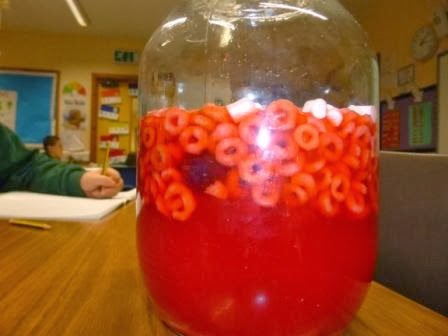
We created " blood cells" in a jar. You can see the red blood cells with some white cells floating in the plasma. The purple pom poms represent platelets.
The microscopes were great for examining blood cells and other cells on slides that we borrowed from the science department at KGS.
The next thing we looked at was the lungs and how they change when we breathe in and out.
We have a model lung in the classroom and here is Emma explaining what happens when we breathe.
The microscopes were great for examining blood cells and other cells on slides that we borrowed from the science department at KGS.
The next thing we looked at was the lungs and how they change when we breathe in and out.
We have a model lung in the classroom and here is Emma explaining what happens when we breathe.
We wanted to find out how our breathing changes when we exercise so we did an experiment. First we rested for two minutes and then counted how many times we breathed in a minute. Next we walked for two minutes and counted again. Finally we ran for two minutes and then counted. We did each action three times and took an average of each one. Most of us found that our breathing rate went up when we exercised.
| Resting |
| Walking |
| Running |
The Human Body
This term we are studying the human body. We started off by researching the yucky things like burps and earwax and creating powerpoints or posters to present to the rest of the class. It was a bit gross but interesting!
We moved on to the digestive system and created a "stomach" with a paper tube and poly bag filled with water. We "fed" it with some bread so that we could get the idea of food being broken down by acid in the stomach.
We tried to look at fat globules in milk but our microscopes were not powerful enough. Instead we made a "lava lamp" with coloured water and oil to show what it might look like.
The addition of fizzy alka seltzer made an interesting effect in the bottle.
We are even growing a brain in the classroom!
We moved on to the digestive system and created a "stomach" with a paper tube and poly bag filled with water. We "fed" it with some bread so that we could get the idea of food being broken down by acid in the stomach.
We tried to look at fat globules in milk but our microscopes were not powerful enough. Instead we made a "lava lamp" with coloured water and oil to show what it might look like.
The addition of fizzy alka seltzer made an interesting effect in the bottle.
We are even growing a brain in the classroom!
Subscribe to:
Posts (Atom)